Abstract
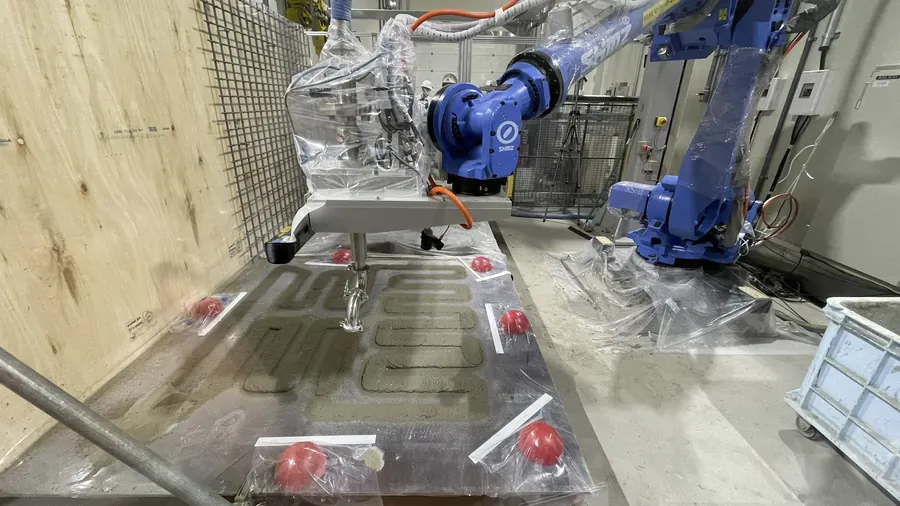
Existing 3D printing simulators target extrusion-based methods, which cannot be directly applied to spray-based methods. This paper presents a new computational method for simulating concrete spray 3D printing, where nozzle position, orientation, and speed are robotically controlled. One of the main benefits of concrete spray 3D printing is the ability to create an arbitrary shape that can support heavy loading and spray over reinforcing bars, or rebar, to create structurally sound architecture. The proposed simulator applies a voxel-based representation of substrate and sprayed concrete, with a novel application of mathematical modeling for concrete dripping, concrete particle rebounding and spread due to airflow, and a semi-transparency parameter to accurately emulate the spray’s flow around rebars. Various physical parameters are also considered in the proposed method including nozzle design, material properties of the concrete mixture, spray apex angle, material rebound, etc. The simulator outputs the mass distribution of the concrete in voxels. Two test cases were performed with a real concrete spray 3D printing robot and replicated in simulation to compare. One test case focuses on the simulator’s capabilities to predict shape based on nozzle motion speeds, producing an average accuracy of$90.75%$in height of sprayed concrete. The second test case showed the simulator’s capabilities to predict printing over a rebar network, resulting in an average accuracy of$92.3%$and$97.9%$for width and thickness, respectively.