
Project Overview
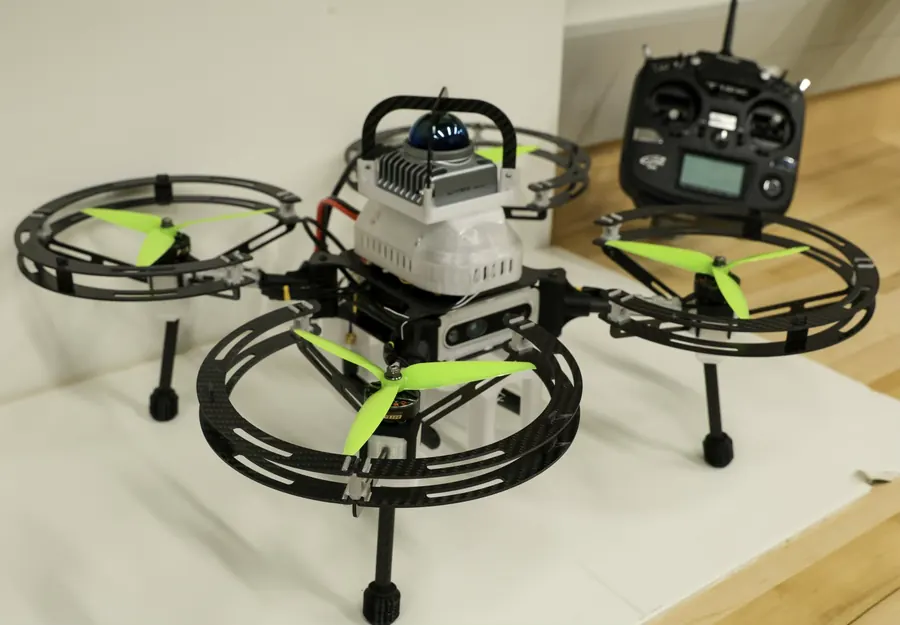
Infrastructure tunnel inspection faces critical challenges with safety hazards, limited accessibility, and high costs associated with manual inspections in confined, GPS-denied environments where traditional navigation systems fail. Our autonomous UAV inspection system addresses these limitations through specialized vision-inertial navigation algorithms that enable stable flight in long tunnels while maintaining safe standoff distances from walls and obstacles. The platform integrates synchronized high-resolution cameras and depth sensors to capture comprehensive visual and geometric data during low-speed autonomous flights. Advanced computer vision algorithms process this data in real-time to maintain precise flight paths while recording detailed structural information for post-flight analysis. The system’s innovative approach eliminates the need for human inspectors to enter potentially dangerous tunnel environments while providing superior data consistency and coverage compared to traditional inspection methods.
The technology delivers transformative benefits for transportation authorities, utility companies, and infrastructure management organizations by enabling rapid, comprehensive tunnel condition assessments with minimal operational disruption. Data products include high-resolution stitched visual maps, precise 3D reconstructions, and automated anomaly detection reports that support predictive maintenance strategies and regulatory compliance documentation. The system reduces inspection time by up to 80% while improving safety outcomes and data quality for critical infrastructure assets including subway tunnels, highway passages, and utility corridors. Our research team combines expertise in autonomous flight systems, computer vision, and infrastructure assessment, actively seeking partnerships with transportation agencies, engineering consultancies, and drone technology companies to deploy this specialized inspection capability across diverse tunnel infrastructure applications.
Related publications
- ASIP-Planner: Adaptive Planning for UAV Surface Inspection in Partially Known Indoor Environments
IEEE/RSJ International Conference on Intelligent Robots and Systems (IROS 2026, accepted) · 2026
- NavRL: Learning Safe Flight in Dynamic Environments
IEEE Robotics and Automation Letters · 2025
- Intent Prediction-Driven Model Predictive Control for UAV Planning and Navigation in Dynamic Environments
IEEE Robotics and Automation Letters · 2025
- LV-DOT: LiDAR-visual dynamic obstacle detection and tracking for autonomous robot navigation
arXiv preprint · 2025
- Onboard Dynamic-Object Detection and Tracking for Autonomous Robot Navigation With RGB-D Camera
IEEE Robotics and Automation Letters · 2024
- Heuristic-based Incremental Probabilistic Roadmap for Efficient UAV Exploration in Dynamic Environments
IEEE International Conference on Robotics and Automation (ICRA) · 2024
- A Vision-Based Autonomous UAV Inspection Framework for Unknown Tunnel Construction Sites With Dynamic Obstacles
IEEE Robotics and Automation Letters · 2023
- Vision-aided UAV Navigation and Dynamic Obstacle Avoidance using Gradient-based B-spline Trajectory Optimization
IEEE International Conference on Robotics and Automation (ICRA) · 2023
- A real-time dynamic obstacle tracking and mapping system for UAV navigation and collision avoidance with an RGB-D camera
IEEE International Conference on Robotics and Automation (ICRA) · 2023
- DPMPC-Planner: A real-time UAV trajectory planning framework for complex static environments with dynamic obstacles
IEEE International Conference on Robotics and Automation (ICRA) · 2022
- Autonomous UAV Exploration of Dynamic Environments Via Incremental Sampling and Probabilistic Roadmap
IEEE Robotics and Automation Letters · 2021