
Project Overview
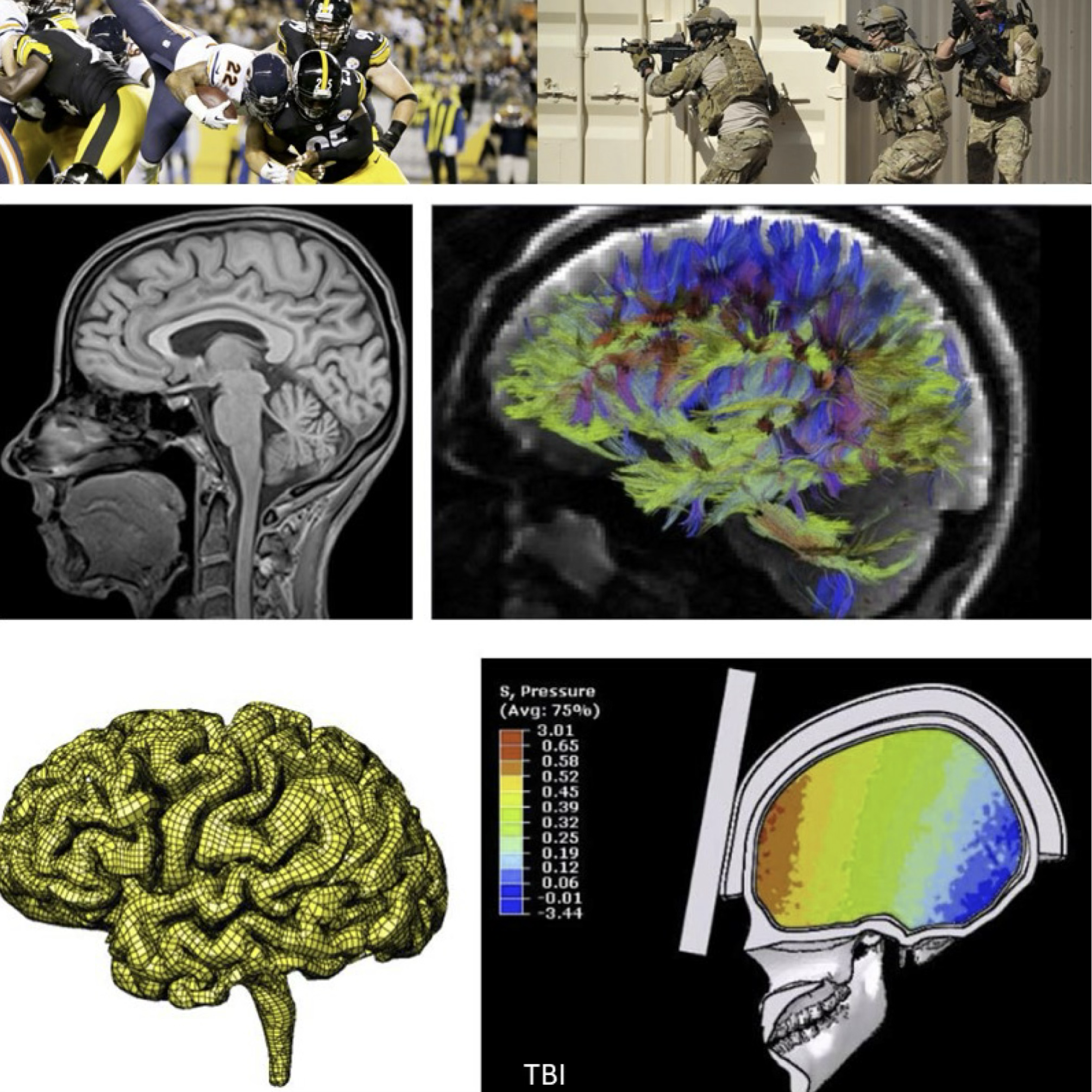
Understanding traumatic brain injury mechanisms remains a critical challenge in neuroscience and safety engineering, as traditional assessment methods cannot predict injury severity or guide protective equipment design effectively. This project develops advanced finite element simulation models that integrate High Definition Fiber Tractography (HDFT) to create unprecedented detail in TBI analysis, relating impact loading directly to tissue strain and neural pathway disruption. The core innovation combines computational mechanics with medical imaging to provide quantitative insights into how different impacts affect specific brain regions and neural fiber networks. Key technical challenges include modeling brain tissue as a complex multi-phase viscoelastic material, implementing large-scale parallel processing for high-fidelity simulations, and validating computational predictions against real clinical data through collaborations with University of Pittsburgh and Pittsburgh Supercomputing Center.
Applications span medical diagnosis support, protective equipment optimization, and safety standard development across healthcare, automotive, and sports industries. The simulation framework enables evidence-based treatment planning, prognosis prediction, and rehabilitation protocol optimization while informing the design of helmets, vehicle safety systems, and workplace protection equipment. Clinical partnerships with UPMC provide real patient data for validation, while PSC resources enable parameter sweeps and large-scale analysis. The interdisciplinary team seeks collaborations with medical institutions for clinical validation, technology companies for commercial software development, and government agencies for public health initiatives, offering opportunities to advance traumatic brain injury research through cutting-edge computational simulation and contribute to injury prevention and treatment strategies.