
Project Overview
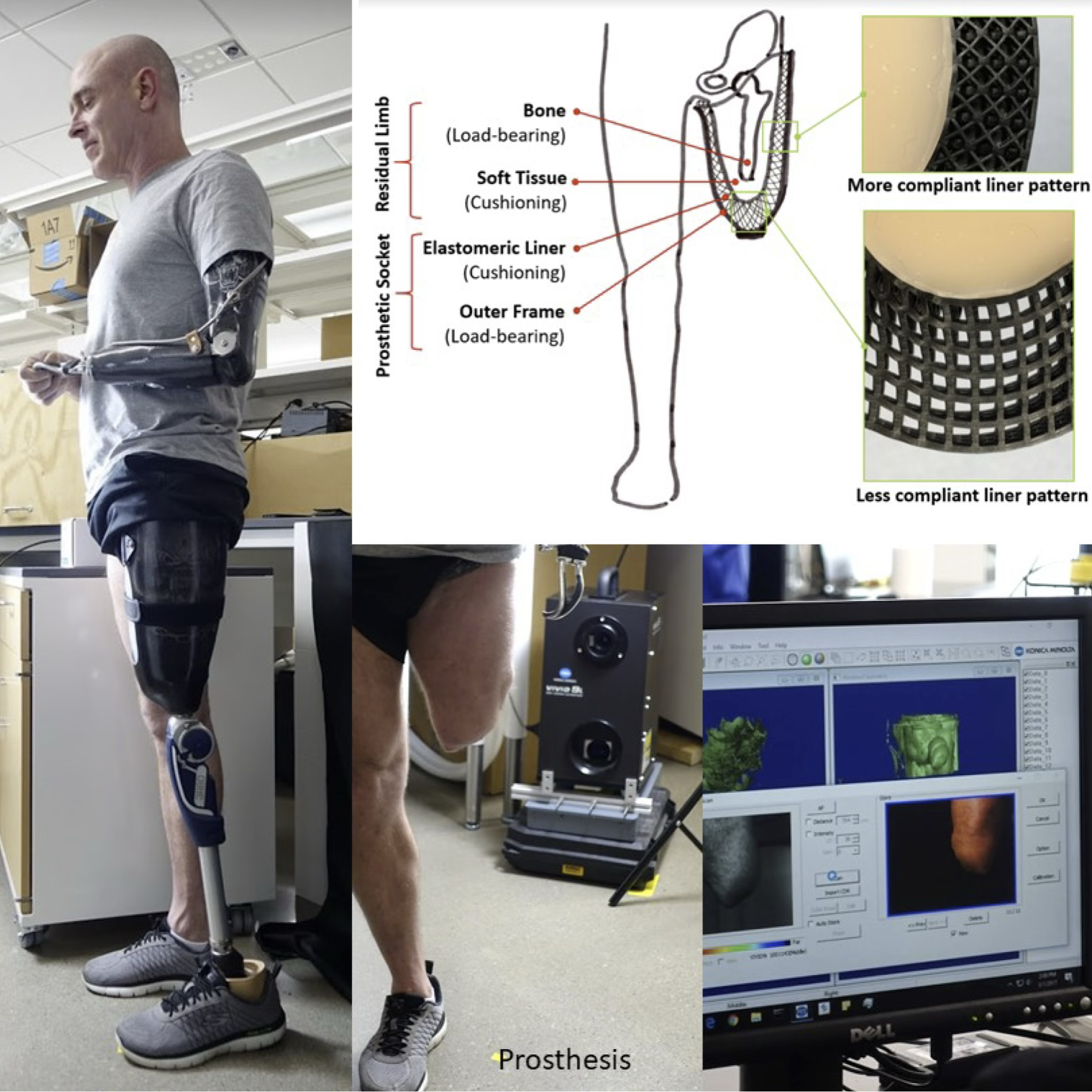
Prosthetic users face significant challenges with traditional one-size-fits-all socket liners that create pressure hotspots, skin breakdown, and discomfort due to mismatched mechanical properties between the rigid prosthetic interface and soft human tissue. Our compliance-matched 3D-printed elastic liner technology addresses this critical problem by developing patient-specific interfaces that match individual anatomy and tissue properties. The core innovation involves using high-resolution 3D scanning combined with advanced material characterization to create custom geometry and graded lattice structures that distribute pressure evenly across the residual limb. Key technical challenges include developing computational algorithms that optimize material stiffness gradients, creating biocompatible 3D printing materials with appropriate elastic properties, and designing manufacturing processes that can produce complex internal structures while maintaining surface quality for skin contact.
This personalized prosthetic liner technology significantly improves patient outcomes by reducing skin breakdown, eliminating pressure sores, and enhancing overall comfort during daily activities and extended wear periods. The technology enables better prosthetic fit and function, leading to increased user satisfaction, improved mobility, and reduced healthcare costs associated with skin complications and frequent liner replacements. Clinical applications span across all levels of amputation and can be adapted for various prosthetic designs, offering prosthetists a new tool for achieving optimal patient outcomes. The manufacturing approach integrates seamlessly with existing clinical workflows, requiring only standard 3D scanning equipment and accessible 3D printing technology. Our research team combines expertise in biomechanics, materials science, and prosthetic design to advance personalized rehabilitation technology. We seek partnerships with prosthetic manufacturers, rehabilitation centers, and healthcare organizations interested in implementing next-generation custom prosthetic interfaces that can transform the quality of life for amputee patients worldwide.