
Project Overview
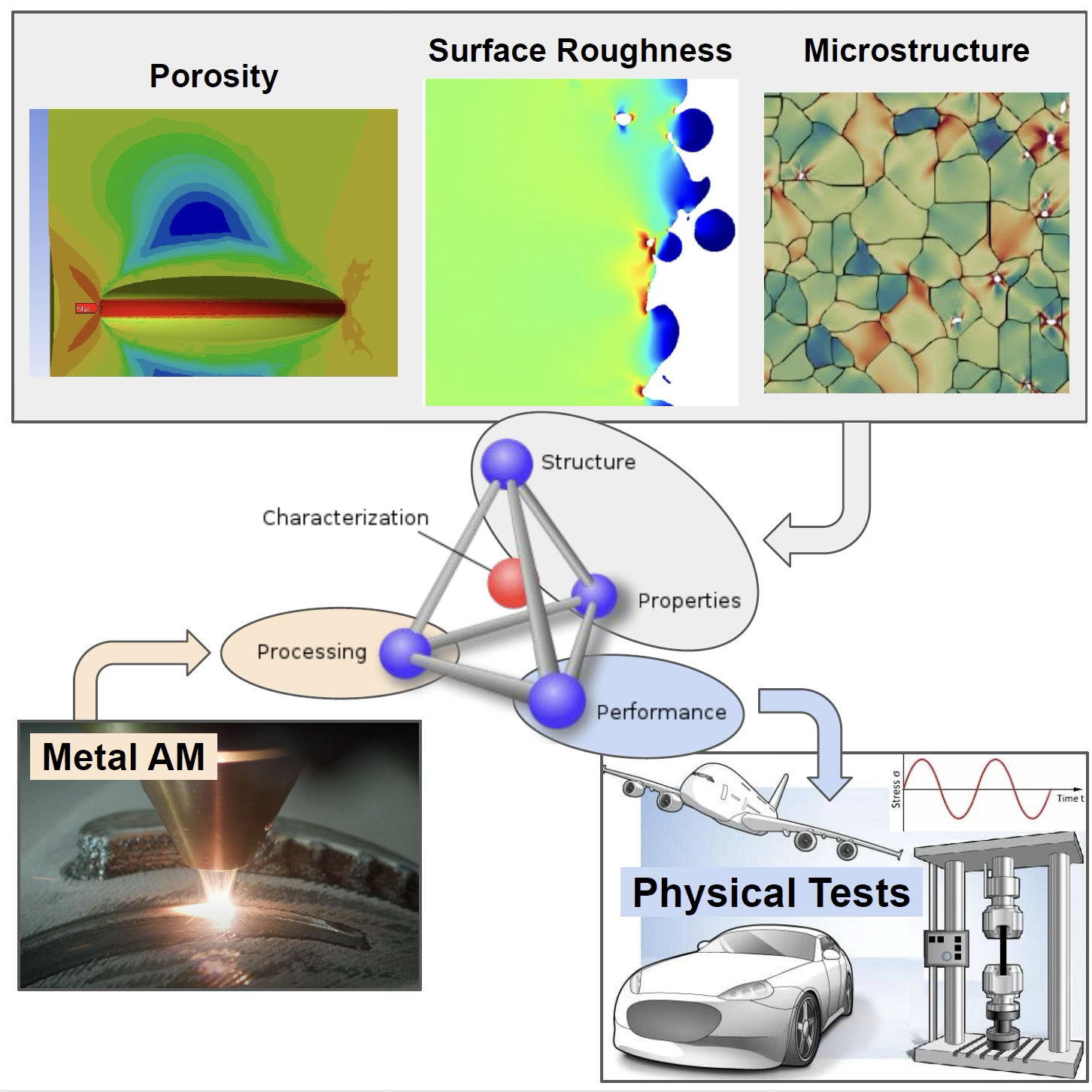
The aerospace industry faces a critical barrier to widespread adoption of metal additive manufacturing: the inability to reliably predict structural performance and obtain certification for flight-critical components. Our computational framework addresses this challenge by developing multi-scale simulation methods that link process-driven microstructure formation to part-level mechanical properties including stiffness, strength, and fatigue behavior. The core technical innovation combines crystal plasticity finite element methods with advanced materials characterization techniques, enabling unprecedented prediction capabilities that span from atomic-level material behavior to full structural component performance. This approach tackles the fundamental problem of uncertainty in AM part properties by creating physics-based models that can predict how printing parameters, thermal histories, and post-processing treatments affect final component reliability.
The technology offers immediate applications in aerospace component design optimization, providing the computational evidence needed for design certification and guidance for optimal manufacturing parameters. Beyond aerospace, the research impacts broader advanced manufacturing sectors including automotive, energy, and medical devices where metal AM components require performance guarantees. Our validated computational workflow reduces certification time, enables lightweight structure optimization, and supports the development of AM-specific design guidelines that unlock the full potential of additive manufacturing. The team combines expertise in computational mechanics, materials science, and advanced characterization techniques, seeking partnerships with aerospace companies, AM equipment manufacturers, and certification bodies interested in accelerating the adoption of metal additive manufacturing through predictive performance modeling.