
Project Overview
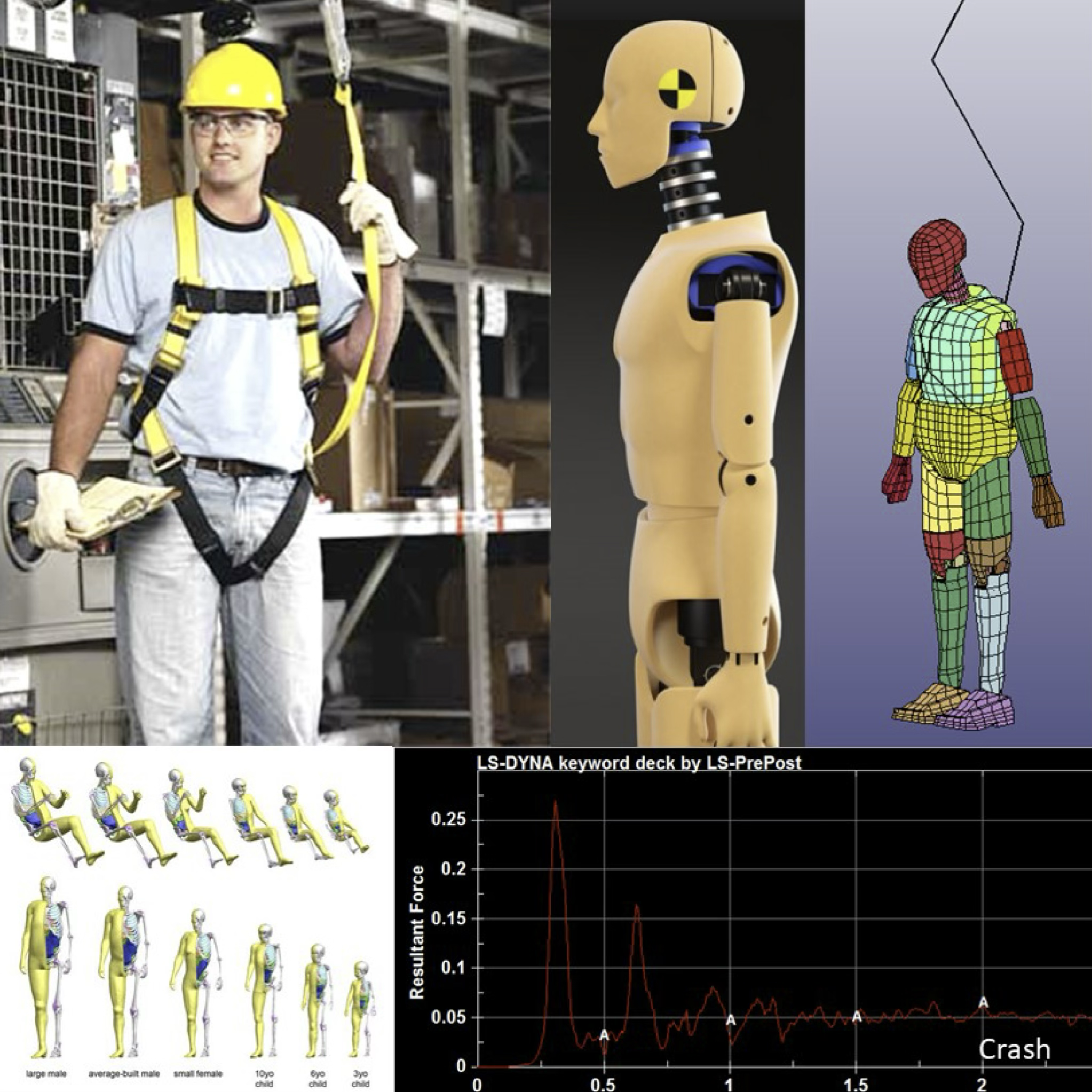
Safety equipment design traditionally relies on costly physical prototyping and limited testing scenarios, often resulting in suboptimal protection that fails to account for the full spectrum of human anatomy and impact conditions. Our research revolutionizes this process by adapting high-fidelity digital crash dummy models from the automotive industry to optimize consumer and industrial safety gear through advanced computational simulation. The core technical innovation combines validated biomechanical human models with sophisticated finite element analysis, numerical optimization algorithms, and high-performance computing to explore millions of design variations that would be impossible to test physically. Our approach enables multi-objective optimization that simultaneously improves protection effectiveness, comfort, manufacturability, and cost-efficiency while ensuring compliance with safety standards and regulations.
This technology transforms safety equipment development across automotive, sports, industrial, and military applications by dramatically reducing development time and costs while improving protection outcomes. Our computational framework enables manufacturers to virtually prototype helmets, harnesses, protective padding, and impact attenuators with unprecedented accuracy, eliminating the need for extensive physical testing during early design phases. The system provides quantitative injury risk assessment and protection effectiveness metrics that support regulatory certification and standards development. Industry applications span from optimizing vehicle occupant protection systems to designing next-generation athletic equipment and workplace safety gear. Our team brings deep expertise in computational mechanics, biomechanics, and safety engineering, seeking partnerships with equipment manufacturers, automotive companies, sports organizations, and regulatory bodies to advance this critical field of protective technology innovation.