
Project Overview
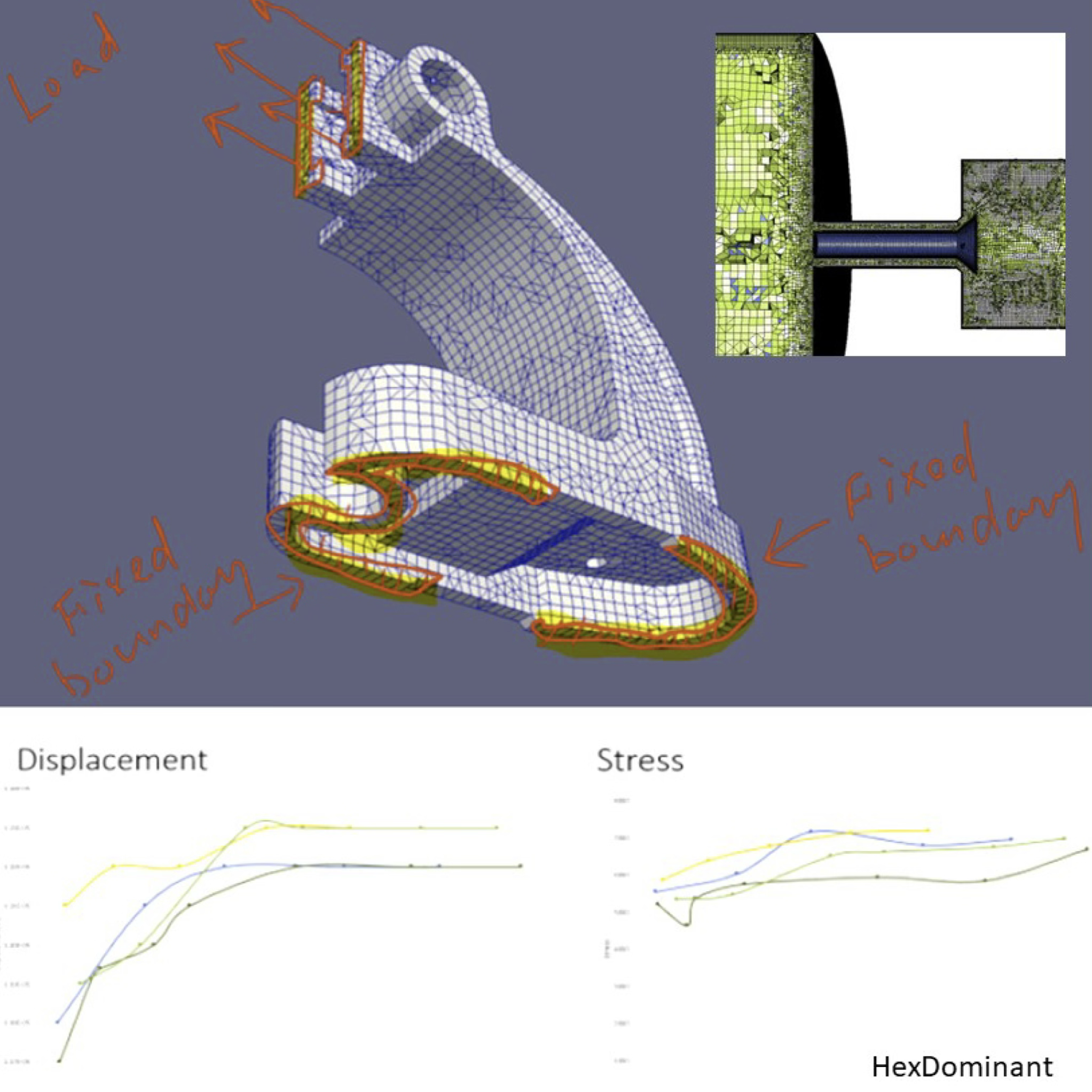
Computational mechanics analysis requires high-quality meshes to produce reliable results, yet the path from complex geometry to analysis-ready discretization remains a significant bottleneck in engineering workflows. We develop automated generation of hex-dominant meshes that combine the robustness of tetrahedral elements with the superior accuracy of hexahedral elements, addressing the fundamental challenge of balancing mesh quality, computational efficiency, and geometric fidelity. Our approach extends beyond traditional meshing by integrating laser-digitized data directly into the simulation pipeline, creating a seamless workflow from physical object scanning to trustworthy computational results. The technical innovation lies in developing algorithms that preserve geometric boundaries, ensure reliable convergence, and automatically adapt mesh density based on both geometric complexity and solution requirements.
The research addresses critical applications across manufacturing, automotive, and aerospace industries where accurate simulation drives design decisions and safety certifications. Our hex-dominant meshing algorithms enable robust analysis of complex geometries that previously required extensive manual cleanup or simplified representations, dramatically reducing the time from design concept to validated analysis. The scan-to-simulation pipeline transforms reverse engineering and quality control processes by enabling direct analysis of manufactured parts, supporting applications from automotive crashworthiness testing to aerospace component certification. We collaborate with industry partners and software companies to integrate these advances into commercial FEM and CFD platforms, while our research team of computational geometry experts, including Professor Kenji Shimada, Soji Yamakawa, and Tomotake Furuhata, continues to push the boundaries of automated mesh generation for next-generation engineering analysis.